Arrest Protection in Dowry Cases in Uttar Pradesh: Police Notice, Anticipatory Bail and Elderly Parents of an NRI
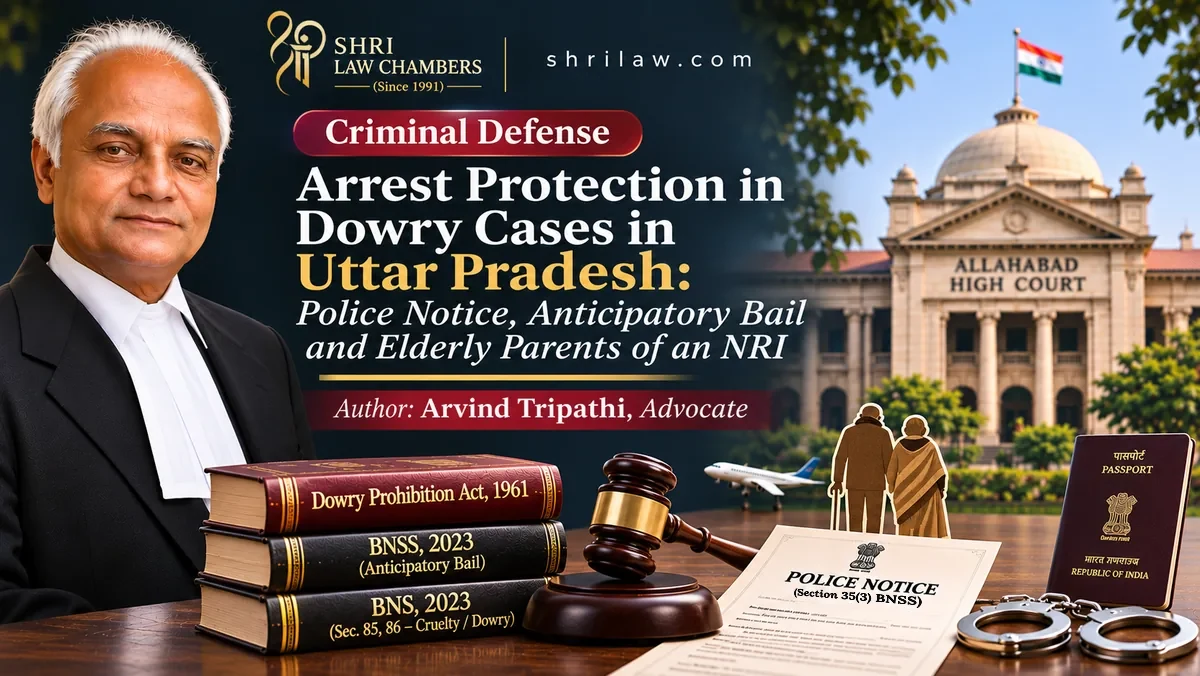
Many dowry FIRs registered in Uttar Pradesh follow a familiar pattern. A wife's complaint names her husband, who may be working abroad, and his parents, who live at home in the district. The charges are usually Section 85 of the Bharatiya Nyaya Sanhita, 2023 (BNS) and Sections 3 and 4 of the Dowry Prohibition Act, 1961. Within days, the question in the family is not yet whether the allegations are true. It is whether the police will come for the parents.
This article makes two points, on the law as it stands on 7 November 2026. First, for the usual dowry FIR, the law treats arrest as the exception: the police are expected to issue a notice of appearance under Section 35(3) of the Bharatiya Nagarik Suraksha Sanhita, 2023 (BNSS), and in Uttar Pradesh a two-month cooling period, laid down by the Allahabad High Court in 2022 and kept in force by the Supreme Court in July 2025, adds a further pause. Second, each of these protections has a gap, and the gaps decide real cases. One section of the Dowry Prohibition Act changes the arithmetic, the new rule for elderly persons is narrower than it looks, and a January 2026 ruling of the Supreme Court has made a common High Court shortcut unreliable. Where a gap applies, the protection that holds is a court order of anticipatory bail.
What the FIR usually charges
Section 85 of the BNS replaced Section 498A of the Indian Penal Code from 1 July 2024. It punishes cruelty by a husband or a relative of the husband with imprisonment which may extend to three years, and fine. Under the First Schedule to the BNSS it is cognizable (where the information comes from the woman or her relatives), non-bailable and triable by a Magistrate of the first class. Non-bailable means that bail is not a matter of right and the court decides. It does not mean that arrest must follow.
The Dowry Prohibition Act sections are often written together as "3/4", but they carry very different punishments. Section 4, demanding dowry, is punishable with imprisonment of six months to two years. Section 3, giving or taking dowry, carries a minimum of five years, and states no maximum. That difference returns below.
The Act has one more feature that is easy to miss. Section 8(1) applies the Code of Criminal Procedure to offences under the Act as if they were cognizable, but expressly not for the arrest of a person without a warrant or without an order of a Magistrate. On its own text, an offence under the Dowry Prohibition Act does not by itself permit an arrest without warrant. The police power to arrest for the Section 85 BNS charge in the same FIR comes from the BNSS.
Notice before arrest
Section 35(1)(b) of the BNSS allows a police officer to arrest without warrant, for an offence punishable with up to seven years, only if the officer has reason to believe that the person committed it and is satisfied that arrest is necessary for one of the listed purposes, such as preventing a further offence, proper investigation, or preventing tampering with evidence. Reasons must be recorded whether the officer arrests or not. Where arrest is not required, Section 35(3) says that the officer shall issue a notice directing the person to appear.
This is the old Section 41A of the Code of Criminal Procedure in a new place, and the case that gave it force was a dowry case. In Arnesh Kumar v. State of Bihar (2014) 8 SCC 273, decided on 2 July 2014, the husband feared arrest under Section 498A IPC and Section 4 of the Dowry Prohibition Act. The Supreme Court directed, in paragraph 11.1, that State Governments instruct the police not to arrest automatically when a Section 498A case is registered, and in paragraph 12 extended its directions to every offence punishable with imprisonment up to seven years.
The Supreme Court has since tightened the position. In Satender Kumar Antil v. CBI, by its decision of 15 January 2026 (2026 SCC OnLine SC 162), it held that for such offences a notice under Section 35(3) is the rule, and that arresting a person who has received the notice is an exception, justified only by real necessity and not by convenience. Earlier, on 16 July 2025, in the same matter (2025 INSC 909), it held that the notice cannot be served by WhatsApp or other electronic means. It must be served in the manner the BNSS provides.
For the family, this has a practical side. The notice must be answered. Section 35(4) makes compliance a duty, and Section 35(5) gives the protection in return: a person who complies, and continues to comply, is not to be arrested for the offence in the notice unless the officer records reasons why arrest has become necessary. Under Section 35(6), a person who fails to comply loses that protection. Parents who receive a notice should appear on the date fixed, keep a copy of the notice, and keep proof of each appearance.
The two-month pause in Uttar Pradesh
Uttar Pradesh has a second layer of protection, and its history is not straight. In Rajesh Sharma v. State of U.P. (2017), a two-Judge Bench of the Supreme Court directed that Section 498A complaints be referred to district Family Welfare Committees, and that ordinarily no arrest be made until the committee reported. A year later, in Social Action Forum for Manav Adhikar v. Union of India (2018) 10 SCC 443, a three-Judge Bench withdrew the directions on Family Welfare Committees as going beyond the Code, while leaving the police to be guided by Arnesh Kumar.
Then, on 13 June 2022, in Mukesh Bansal v. State of U.P. (Criminal Revision No. 1126 of 2022; 2022 SCC OnLine All 395), Justice Rahul Chaturvedi of the Allahabad High Court laid down a "cooling period". For two months from the FIR or complaint, there is to be no arrest or police action against the named accused, and the matter is to be referred to a Family Welfare Committee of the district, constituted under the District Legal Services Authority. The committee meets both sides and reports after the two months. The investigating officer may meanwhile continue a peripheral investigation, such as medical reports and witness statements. The guidelines are meant for Section 498A cases, with other offences punishable with less than ten years, where no injury is alleged; the reported wording on cases that also invoke Section 307 IPC (attempt to murder) is awkward, and should be read in the judgment itself.
The Supreme Court revived these guidelines in a later round of the same family's litigation. In Shivangi Bansal v. Sahib Bansal, 2025 INSC 883, decided on 22 July 2025 by Chief Justice B.R. Gavai and Justice Augustine George Masih, the Court directed, in paragraph 26, that the High Court's guidelines on Family Welfare Committees "shall remain in effect and be implemented by the appropriate authorities".
There is a serious argument that this is not the last word. Shivangi Bansal is a decision of two Judges, and Social Action Forum, which withdrew similar directions, is a decision of three. Commentators, including a column on Bar & Bench and a post on the Law and Other Things blog, have criticised the endorsement on that ground, and also because a blanket two-month bar on arrest takes no account of strong cases of abuse. Let us assume, for the purposes of argument, that the criticism is right. It would still not help the police in Uttar Pradesh today. A direction of the Supreme Court binds the authorities until it is modified, and we have not found any order modifying it.
The real difficulty is practical. The scheme depends on a committee that exists and meets. We have not been able to confirm that a Family Welfare Committee is functioning in every district of Uttar Pradesh. A family named in a fresh FIR can ask at the District Legal Services Authority whether the case has been referred, and should not assume that two months of safety follow automatically.
Elderly parents
Section 35(7) of the BNSS is new, and it was written with parents in mind. No arrest is to be made without the prior permission of an officer not below the rank of Deputy Superintendent of Police where the offence is punishable with imprisonment of less than three years and the person is infirm or above sixty years of age.
Read the condition again. Section 85 of the BNS is punishable with imprisonment which may extend to three years. Three years is not less than three years. On its plain words, therefore, Section 35(7) covers a parent accused only under Section 4 of the Dowry Prohibition Act, punishable with two years at most, but not the Section 85 charge that is usually the main one in a dowry FIR, and not Section 3 of the Act. We have not found a decision of the Allahabad High Court or the Supreme Court on whether Section 35(7) should be read more widely. Until there is one, a parent above sixty should rely first on Section 35(3) and Arnesh Kumar, which apply to every offence punishable up to seven years, and treat Section 35(7) as an additional argument rather than the main protection.
When Section 3 is added
The arithmetic of the FIR matters for a similar reason. Section 35(1)(b) and the Arnesh Kumar directions apply to offences punishable with imprisonment which may be less than seven years or which may extend to seven years. Section 3 of the Dowry Prohibition Act prescribes a minimum of five years and states no maximum. Where it is invoked, the State may argue that the case falls outside the seven-year category altogether.
The answer usually lies in the FIR. Section 3 punishes giving or taking dowry. A complaint about demands and harassment after the marriage often discloses, at most, a demand punishable under Section 4. Whether Section 3 is properly invoked on the facts should therefore be raised specifically, in reply to the police, in an anticipatory bail application, and in any quashing petition.
The writ that no longer settles it
A common course for a family in Uttar Pradesh named in a dowry FIR has been a writ petition under Article 226 of the Constitution to quash it, and such petitions have sometimes ended in a short order. In Chandra Kant v. State of U.P., decided by a Division Bench of the Allahabad High Court on 17 November 2025 (2025:AHC:204372-DB), the FIR was under Sections 85, 115(2) and 351(3) of the BNS and Sections 3/4 of the Dowry Prohibition Act. Counsel made what the order records as an "innocuous prayer", the State had no objection, and the petition was disposed of with a direction that the arrest procedure follow Arnesh Kumar and Section 35(3) of the BNSS. The inclusion of Section 3 did not stand in the way.
Two months later, the Supreme Court cast doubt on that route. In Practical Solutions Inc. v. State of Telangana, decided on 19 January 2026 by Justices J.B. Pardiwala and Satish Chandra Sharma (2026 LiveLaw (SC) 74), a High Court had disposed of a petition to quash an FIR, on its first listing and without hearing the complainant, with a direction to the police to comply with Section 41A of the Code. The Supreme Court set the order aside. Relying on Neeharika Infrastructure (P) Ltd. v. State of Maharashtra (2021) 19 SCC 401 (paragraphs 9 to 13 of its order), it held that such a direction gives the accused, indirectly, a protection that can be considered only if a prima facie case for quashing is made out. The case was not a dowry case and it came from Telangana, but the principle applies to every High Court.
The consequence is that a writ petition must now be argued as a quashing petition, on its merits, under the tests explained in our articles on Article 226 and Section 528 and on quashing for the husband's relatives. Protection from arrest, as such, belongs to anticipatory bail.
Anticipatory bail: which court, and what spoils it
Section 482 of the BNSS allows a person who fears arrest for a non-bailable offence to apply to the Court of Session or the High Court for a direction that he be released on bail if arrested. In Uttar Pradesh the remedy was abolished in 1976 and restored in 2019; its present scope is explained in our separate article on anticipatory bail in Uttar Pradesh. Two points matter particularly in dowry cases.
The first is which court to approach. In Manjeet Singh v. State of U.P., decided on 7 August 2025, the Supreme Court set aside an order of the Allahabad High Court that had sent an applicant back to the Sessions Court, holding that the two courts have concurrent jurisdiction. Other Benches, as in Jagdeo Prasad v. State of Bihar (2025), have said that the Sessions Court should ordinarily come first. The question is now before a three-Judge Bench in Mohammed Rasal C. v. State of Kerala (SLP (Crl.) No. 6588 of 2025), which has reserved judgment. As far as we have been able to find, no judgment had been pronounced by 7 November 2026. Until it is, the Sessions Court is the safer first step, unless there is a specific reason to go to the High Court directly, which should then be set out in the application.
The second is conduct. In Srikant Upadhyay v. State of Bihar, decided on 14 March 2024, the Supreme Court held that a person who has evaded warrants, so that a proclamation has been issued against him, is ordinarily not entitled to anticipatory bail. A family that ignores the notice under Section 35(3), or the court's summons after the charge-sheet, weakens the very application it may later need.
A son abroad stands differently. He can apply through counsel, but several High Courts have held that he must be in India before the final hearing. That position, with the passport and Look Out Circular questions, is explained in our article for Indians living abroad with a criminal or dowry case in India.
What to keep ready
• The FIR, with the sections exactly as written, and any notice under Section 35(3), with the date and manner of its service.
• Proof of each appearance before the police in answer to a notice.
• Proof of age for a parent above sixty, and medical records if a parent is unwell.
• Proof of where each family member lived during the period alleged in the FIR.
• The dates of the marriage, the separation and the complaint, and of any divorce, maintenance or domestic violence case.
• Any notice, letter or report from a Family Welfare Committee or a mediation centre.
Conclusion
Go back to the parents in the first paragraph. If the FIR is the usual one, the law does not expect the police to arrest them on the strength of the complaint alone. It expects a notice and, in Uttar Pradesh, a pause of two months while a committee tries to settle the matter. If they answer the notice, and keep answering it, the police must record why arrest has become necessary before they can make one.
What the law does not yet do is make that protection certain. Whether a committee is actually sitting in their district, whether Section 35(7) can help a parent charged under Section 85, and which court the three-Judge Bench in Mohammed Rasal will tell them to approach first, are all open on 7 November 2026. Where any of these matters on the facts, the safer course is not to wait for the police to decide, but to put the question to a court in an anticipatory bail application, with the papers ready. Each case turns on its own FIR and record, and no outcome can be assumed.
Key Authorities Cited
- Arnesh Kumar v. State of BiharSupreme Court of India, 2014-07-02(2014) 8 SCC 273; 2014 INSC 463Paras: 11.1, 12
- Satender Kumar Antil v. Central Bureau of InvestigationSupreme Court of India, 2026-01-152026 SCC OnLine SC 162
- Satender Kumar Antil v. Central Bureau of Investigation (application of the State of Haryana)Supreme Court of India, 2025-07-162025 INSC 909
- Rajesh Sharma v. State of U.P.Supreme Court of India, 2017-07-27AIR 2017 SC 3869
- Social Action Forum for Manav Adhikar v. Union of IndiaSupreme Court of India (three Judges), 2018-09-14(2018) 10 SCC 443
- Mukesh Bansal v. State of U.P.Allahabad High Court, 2022-06-13Criminal Revision No. 1126 of 2022; 2022 SCC OnLine All 395
- Shivangi Bansal v. Sahib BansalSupreme Court of India, 2025-07-222025 INSC 883; 2025 SCC OnLine SC 1494Paras: 26
- Chandra Kant v. State of U.P.Allahabad High Court (Division Bench), 2025-11-172025:AHC:204372-DBParas: 2, 6
- Practical Solutions Inc. v. State of TelanganaSupreme Court of India, 2026-01-19Criminal Appeal No. 353 of 2026; 2026 LiveLaw (SC) 74Paras: 9, 10, 11, 12, 13
- Neeharika Infrastructure (P) Ltd. v. State of MaharashtraSupreme Court of India(2021) 19 SCC 401
- Manjeet Singh v. State of U.P.Supreme Court of India, 2025-08-07
- Mohammed Rasal C. v. State of KeralaSupreme Court of India (three Judges; judgment reserved)SLP (Crl.) No. 6588 of 2025
- Srikant Upadhyay v. State of BiharSupreme Court of India, 2024-03-142024 SCC OnLine SC 282
Statutory Provisions
- Bharatiya Nyaya Sanhita, 2023 - Section 85 (cruelty by husband or relative of husband; formerly Section 498A IPC)
- Bharatiya Nagarik Suraksha Sanhita, 2023 - Section 35(1)(b) and (3) to (6) (arrest without warrant; notice of appearance; formerly Sections 41 and 41A CrPC)
- Bharatiya Nagarik Suraksha Sanhita, 2023 - Section 35(7) (no arrest of a person who is infirm or above sixty, for an offence punishable with less than three years, without permission of a Deputy Superintendent of Police)
- Bharatiya Nagarik Suraksha Sanhita, 2023 - Section 482 (anticipatory bail; formerly Section 438 CrPC)
- Bharatiya Nagarik Suraksha Sanhita, 2023 - First Schedule (classification of Section 85 BNS)
- Dowry Prohibition Act, 1961 - Sections 3 and 4 (giving or taking dowry; demanding dowry)
- Dowry Prohibition Act, 1961 - Section 8(1) (offences cognizable for certain purposes, not for arrest without warrant or Magistrate's order)
- Constitution of India - Article 226
Frequently Asked Questions
The police have called my parents to the police station in a dowry case. Does that mean they will be arrested?
Not by itself. A notice under Section 35(3) BNSS is the alternative to arrest. If they appear and keep cooperating, the police can arrest them only after recording reasons why arrest has become necessary. Ignoring the notice is what removes that protection.
Is there really a two-month period in Uttar Pradesh when no one can be arrested in a dowry case?
The Allahabad High Court's guidelines in Mukesh Bansal (2022), which the Supreme Court directed to remain in effect in Shivangi Bansal (2025), provide for a two-month cooling period from the FIR, during which the case goes to a Family Welfare Committee and no arrest is to be made. Preliminary investigation can continue. Whether a committee is functioning in your district should be checked with the District Legal Services Authority.
My father is 68. Doesn't the new law protect people over sixty from arrest?
Only partly. Section 35(7) BNSS requires a Deputy Superintendent of Police's prior permission to arrest a person above sixty or infirm, but only for offences punishable with less than three years. Section 85 BNS carries up to three years, so on the words of the section it may not cover that charge. The general notice rule under Section 35(3) still applies to him.
Should we apply for anticipatory bail in the Sessions Court or the High Court?
Both have the power under Section 482 BNSS. In Manjeet Singh (2025) the Supreme Court held that the High Court could not send an applicant back merely because he had not gone to the Sessions Court, but a three-Judge Bench is now deciding whether the Sessions Court should ordinarily come first. Until it rules, the Sessions Court is usually the first step.
The FIR also mentions Section 3 of the Dowry Prohibition Act. Does that make a difference?
It can. Section 3 carries a minimum of five years, so the State may argue that the seven-year notice rule does not apply. Section 3 is about giving or taking dowry; where the complaint is really about demands after the marriage, that point should be raised specifically.
Can the High Court simply direct the police to follow the notice procedure?
Since Practical Solutions Inc. v. State of Telangana (January 2026), the Supreme Court has said that a High Court hearing a quashing petition should not give that direction unless it finds a prima facie case for quashing. The petition has to be argued on its merits, and protection from arrest is sought through anticipatory bail.
Sources & References
- Arnesh Kumar v. State of Bihar: directions in paragraphs 11 and 12, as notified by the Delhi High Court (Delhi High Court)
- Satender Kumar Antil v. CBI, 2026 SCC OnLine SC 162, decided 15 January 2026 (SCC Online Blog)
- Satender Kumar Antil v. CBI, 2025 INSC 909: notice under Section 35 BNSS cannot be served electronically (Verdictum)
- Mukesh Bansal v. State of U.P., 13 June 2022: cooling period and Family Welfare Committees (LiveLaw)
- Shivangi Bansal v. Sahib Bansal, 2025 INSC 883, judgment dated 22 July 2025 (Supreme Court of India)
- Practical Solutions Inc. v. State of Telangana, 19 January 2026 (LiveLaw)
- Mohammed Rasal C. v. State of Kerala: three-Judge Bench reserves judgment (LawChakra)
- Manjeet Singh v. State of U.P., 7 August 2025 (LawBeat)
- Srikant Upadhyay v. State of Bihar, 14 March 2024 (Supreme Court of India)
- Section 35 BNSS – when police may arrest without warrant (ApniLaw bare act)
- Dowry Prohibition Act, 1961 (India Code)
- Judicial safeguards or overreach? Rethinking the Supreme Court's approach to Section 85 BNS (Bar & Bench)
- When Procedure Becomes Policy: A Constitutional Critique of Family Welfare Committees in Section 498A Cases (Law and Other Things)

Shri Law Chambers. Practises before the Allahabad High Court in service and criminal matters; in practice since 1991.
Enrolled with the Bar Council of Uttar Pradesh, 1991 · Advocate-on-Record, Allahabad High Court · Allahabad High Court Bar Association · LL.B., Faculty of Law, University of Allahabad, 1990 · Former standing counsel: Government of India; Zila Panchayat, Kanpur Nagar; Fisheries Department (Matsya Palan Vibhag), Government of Uttar Pradesh
Related Articles
NRI Husband's Family Named in a Dowry FIR in Uttar Pradesh: Quashing for Relatives in the Allahabad High Court
When a wife's dowry or cruelty FIR in Uttar Pradesh names the NRI husband's parents, brothers and sisters, the relatives can ask the Allahabad High Court to quash the case against them if the allegations are general. This article explains the Supreme Court's test, the common situations, the right petition at each stage and the documents that matter.
Living Abroad With a Criminal or Dowry Case in India: Notice, Passport, Look Out Circulars, Anticipatory Bail and Quashing
Many Indians living abroad learn of a criminal case in India – often a dowry or cruelty FIR filed by a spouse – only after it is registered. This article explains, for cases in Uttar Pradesh, what a police notice means, whether a passport can be impounded, how Look Out Circulars are treated by the courts, whether anticipatory bail can be sought from abroad, how quashing works, and when the offence is treated as committed outside India.
Writ Under Article 226 or Application Under Section 528 BNSS? Choosing the Right Route to Quash an FIR in the Allahabad High Court
In the Allahabad High Court, an FIR at the investigation stage is ordinarily challenged by a writ petition under Article 226, while a charge-sheet and cognizance order are challenged under Section 528 BNSS. This article explains why, what the Supreme Court has said, and the nine-Judge reference that may change the position.
Anticipatory Bail in Uttar Pradesh Under Section 482 BNSS: Who Can Apply, Restrictions, and Sessions Court or High Court
Anticipatory bail was abolished in Uttar Pradesh in 1976 and restored in 2019 with exceptions. It is now governed by Section 482 of the BNSS. This article explains who can apply, whether the 2019 Uttar Pradesh restrictions for NDPS, Gangsters Act and capital cases still apply, the bars that remain, whether the Sessions Court must be approached before the Allahabad High Court, and how long the protection lasts.