NDPS Bail in the Allahabad High Court: Quantity, Section 37 and Long Custody
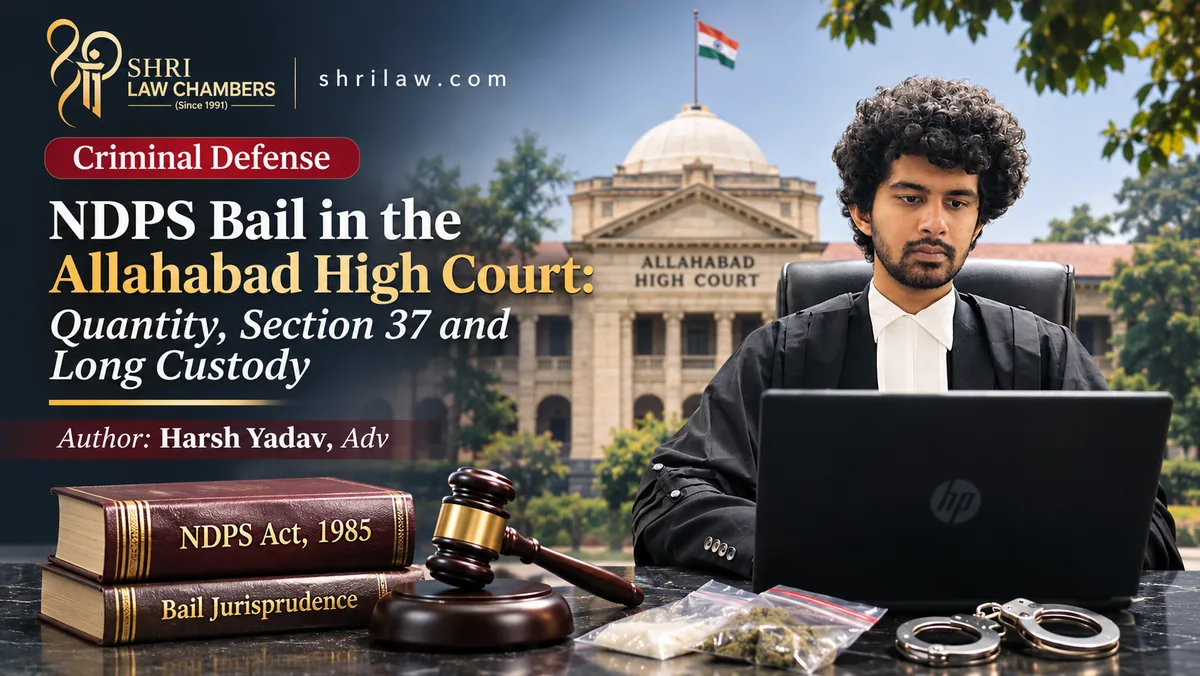
Most cases under the Narcotic Drugs and Psychotropic Substances Act, 1985 (the NDPS Act) begin with an arrest and a recovery – ganja, charas, smack (heroin), poppy straw (doda) or tablets and syrups. The first question the family usually asks is whether bail is possible and how long it will take. The answer depends, more than anything else, on the quantity recovered. This article explains the route to the Allahabad High Court and the rules the Court applies.
Which court, and in what order
NDPS offences are tried by Special Courts constituted under Section 36 of the Act, presided over by a Sessions Judge or Additional Sessions Judge. A bail application is ordinarily made first to the Special Court. If it is rejected, a fresh application can be filed in the Allahabad High Court under Section 483 of the Bharatiya Nagarik Suraksha Sanhita, 2023 (BNSS), which corresponds to Section 439 of the old Code. Section 36A(3) of the NDPS Act expressly preserves the High Court's power to grant bail in these cases.
The High Court application is not an appeal against the Special Court's order. The High Court looks at the case afresh, on the record placed before it, and the State is given notice and an opportunity to oppose.
Why the quantity decides almost everything
For each drug, the Central Government has notified a 'small quantity' and a 'commercial quantity'. Anything between the two is 'intermediate'. Some common examples from the notified table:
• Ganja: small quantity up to 1 kg; commercial quantity 20 kg or more
• Charas (hashish): small up to 100 grams; commercial 1 kg or more
• Heroin (smack): small up to 5 grams; commercial 250 grams or more
• Cocaine: small up to 2 grams; commercial 100 grams or more
• Poppy straw (doda): small up to 1 kg; commercial 50 kg or more
• Codeine: small up to 10 grams; commercial 1 kg or more
The punishment follows the same three bands. For small quantity, the maximum is rigorous imprisonment up to one year, or fine up to ₹10,000, or both (the limit was raised from six months by the 2014 amendment). For intermediate quantity, it is up to 10 years and fine up to ₹1 lakh. For commercial quantity, it is a minimum of 10 and a maximum of 20 years, with fine of ₹1 lakh to ₹2 lakh.
The weight that counts is the weight of the whole mixture seized, not only the pure drug content. A three-Judge Bench of the Supreme Court settled this in Hira Singh v. Union of India (2020) 20 SCC 272, holding that the neutral substance in a mixture is not to be excluded when deciding whether the quantity is small or commercial. In practice, therefore, the recovery memo and the weight recorded at the time of seizure matter greatly.
Small and intermediate quantity: ordinary bail principles
Where the recovered quantity is small or intermediate, Section 37 does not apply. Bail is decided on the ordinary principles: the nature of the accusation, the material collected, the period already spent in custody, the stage of the case, the likelihood of the accused appearing for trial, and any criminal history. Offences in these bands are still serious, but bail is not subject to the special statutory bar.
Commercial quantity: the Section 37 conditions
Section 37(1)(b) of the NDPS Act applies to offences involving commercial quantity (and to offences under Sections 19, 24 and 27A). A person accused of such an offence is not to be released on bail unless two conditions are met:
• the Public Prosecutor has been given an opportunity to oppose the application; and
• where the Public Prosecutor opposes it, the court is satisfied that there are reasonable grounds for believing that the accused is not guilty of the offence and that he is not likely to commit any offence while on bail.
Section 37(2) makes these limitations an addition to the ordinary law of bail, not a replacement for it.
The Supreme Court has explained how strict the test is. In State of Kerala v. Rajesh (decided 24 January 2020), it held that the conditions are cumulative, and that 'reasonable grounds' means something more than prima facie grounds: there must be substantial, probable reasons, based on the facts of the case, for believing that the accused is not guilty. At the same time, in Union of India v. Rattan Mallik (2009) 2 SCC 624, it held that the court is not called upon to record a finding that the accused is not guilty, and that the evidence is not to be weighed meticulously at the bail stage. The satisfaction is for the limited purpose of bail.
What the High Court looks at in a commercial-quantity case
Because the Court must form a view on 'reasonable grounds', the details of the record carry great weight. Points that commonly arise include:
• whether the recovery was from the person of the accused, a bag, a vehicle or premises, and whether Section 50 of the Act applied and was complied with;
• how the samples were drawn and certified, including before a Magistrate under Section 52A;
• what the forensic (FSL) report says, and whether it matches the quantity and substance described in the recovery memo;
• whether the accused was found in conscious possession, or is implicated only by a co-accused's statement;
• the role attributed to each accused, for example the driver of a vehicle as against its owner or the person who loaded the goods; and
• criminal history, which bears directly on the second condition – whether the accused is likely to commit an offence while on bail.
The search and sampling requirements, and how a lapse affects trial and bail, are explained in a separate article on NDPS search and seizure. Whether a particular lapse is serious enough is often a matter for evidence at the trial, and the Court may decline to decide it finally at the bail stage.
Long custody and delay in the trial
Section 37 does not shut the door where the trial is unduly delayed. In Mohd. Muslim @ Hussain v. State (NCT of Delhi) (decided 28 March 2023), the Supreme Court granted bail to an undertrial who had spent about seven years in custody, holding that Section 37 does not prevent bail on the ground of undue delay, and that a literal reading of the conditions would make bail impossible. In Rabi Prakash v. State of Odisha (order dated 13 July 2023), where the accused had spent more than three and a half years in custody in a case involving 247 kg of ganja, the Court held that prolonged incarceration is against Article 21 and that conditional liberty must override the statutory embargo under Section 37.
These decisions do not lay down a fixed period after which bail must follow. The Court considers the period already spent, the number of witnesses examined and still to be examined, the reasons for the delay, and the conduct of the accused.
Default bail if the charge-sheet is late
Where the police do not file the charge-sheet within the time allowed, the accused can claim default bail as of right, provided he applies before the charge-sheet is filed. For offences involving commercial quantity (and offences under Sections 19, 24 and 27A), Section 36A(4) of the NDPS Act extends the ordinary period to 180 days. The Special Court may extend it up to one year, but only on a report of the Public Prosecutor showing the progress of the investigation and specific reasons for keeping the accused in custody beyond 180 days. For other NDPS offences, the ordinary periods under Section 187 of the BNSS apply.
Anticipatory bail
Anticipatory bail in NDPS cases in Uttar Pradesh is a separate question. The Lucknow Bench of the Allahabad High Court, in Sudhir @ Sudhir Kumar Chaurasia v. State of U.P. (2025:AHC-LKO:34988), held that an application under Section 482 of the BNSS is maintainable in an NDPS case, while the strictness of the Act is weighed when the application is decided. This is discussed in our article on anticipatory bail in Uttar Pradesh.
Documents that matter
For a High Court bail application in an NDPS case, it helps to have ready:
• the FIR and the recovery memo (fard baramadgi), with the recorded weight;
• the order of the Special Court rejecting bail;
• the forensic (FSL) report, if received, and the sampling papers;
• the charge-sheet, if filed, with the list of witnesses;
• a custody certificate showing the period spent in jail; and
• details of any other criminal cases, with their status.
Summary
In an NDPS case, bail turns first on quantity. For small and intermediate quantities, ordinary bail principles apply. For commercial quantity, Section 37 requires the court to find reasonable grounds for believing that the accused is not guilty and is not likely to offend while on bail – a strict test, but one applied on the record and without a final finding of guilt. Lapses in search, sampling or the forensic report can bear on that test. Long custody with a slow trial is a separate and recognised ground, and a late charge-sheet can give a right to default bail after 180 days in commercial-quantity cases. After rejection by the Special Court, the application lies to the Allahabad High Court under Section 483 of the BNSS. Each case depends on its own record, and no outcome can be assumed.
Key Authorities Cited
- Hira Singh v. Union of IndiaSupreme Court of India (three-Judge Bench), 2020-04-22(2020) 20 SCC 272
- State of Kerala v. RajeshSupreme Court of India, 2020-01-24Criminal Appeal Nos. 154–157 of 2020
- Union of India v. Rattan Mallik @ HabulSupreme Court of India, 2009-01-23(2009) 2 SCC 624
- Mohd. Muslim @ Hussain v. State (NCT of Delhi)Supreme Court of India, 2023-03-28SLP (Crl.) No. 915 of 2023
- Rabi Prakash v. State of OdishaSupreme Court of India, 2023-07-13SLP (Crl.) No. 4169 of 2023
- Sudhir @ Sudhir Kumar Chaurasia v. State of U.P.Allahabad High Court (Lucknow Bench)2025:AHC-LKO:34988
Statutory Provisions
- Narcotic Drugs and Psychotropic Substances Act, 1985 - Section 37 (offences to be cognizable and non-bailable; conditions for bail in commercial-quantity cases)
- Narcotic Drugs and Psychotropic Substances Act, 1985 - Section 36A(3) (High Court's power to grant bail preserved) and Section 36A(4) (180 days for investigation, extendable up to one year)
- Narcotic Drugs and Psychotropic Substances Act, 1985 - Sections 20 and 21 (punishment by small, intermediate and commercial quantity)
- Bharatiya Nagarik Suraksha Sanhita, 2023 - Section 483 (bail by the High Court or Court of Session; corresponds to Section 439 CrPC)
- Bharatiya Nagarik Suraksha Sanhita, 2023 - Section 187 (detention during investigation and default bail)
Frequently Asked Questions
Can bail be granted in an NDPS case involving commercial quantity?
Yes, but only if the Section 37 conditions are met: the Public Prosecutor must be heard, and if he opposes, the court must be satisfied that there are reasonable grounds for believing that the accused is not guilty and is not likely to commit an offence while on bail. Long custody with an undue delay in the trial is also a recognised ground.
Does Section 37 apply to small or intermediate quantity?
No. Section 37(1)(b) applies to commercial quantity and to offences under Sections 19, 24 and 27A. For small and intermediate quantities, bail is decided on ordinary principles.
Is the weight of the pure drug or the whole mixture counted?
The whole mixture. In Hira Singh v. Union of India (2020), the Supreme Court held that the neutral substance in a mixture is not excluded when deciding whether the quantity is small or commercial.
Where do I apply after the Special Court rejects bail?
To the Allahabad High Court, by a fresh bail application under Section 483 of the BNSS. Section 36A(3) of the NDPS Act preserves the High Court's power to grant bail in NDPS cases.
What is default bail in an NDPS case?
If the charge-sheet is not filed in time, the accused can claim bail as of right by applying before it is filed. In commercial-quantity cases the period is 180 days, which the Special Court can extend up to one year only on the Public Prosecutor's report giving the progress of the investigation and specific reasons.
Can anticipatory bail be sought in an NDPS case in Uttar Pradesh?
The Lucknow Bench of the Allahabad High Court has held that an application under Section 482 of the BNSS is maintainable in an NDPS case, though the strictness of the Act is weighed when it is decided.
Sources & References
- Narcotic Drugs and Psychotropic Substances Act, 1985 (India Code)
- Punishment for offences under the NDPS Act and notified quantities (Department of Revenue, Government of India)
- Narcotic Drugs and Psychotropic Substances (Amendment) Act, 2014 (PRS India)
- State of Kerala v. Rajesh, 24 January 2020 (LiveLaw)
- Section 37 NDPS Act: principles for bail in commercial-quantity cases, including Rattan Mallik (LiveLaw)
- Rabi Prakash v. State of Odisha, 13 July 2023 (LiveLaw)
- Mohd. Muslim v. State (NCT of Delhi), 28 March 2023 (LiveLaw)

Shri Law Chambers. Practises before the Delhi High Court in Enforcement Directorate, PMLA and arbitration matters.
Enrolled with the Bar Council of Rajasthan, 2020 · Delhi High Court Bar Association
Related Articles

एनडीपीएस मामले में जमानत: इलाहाबाद उच्च न्यायालय, मात्रा, धारा 37 और लंबी हिरासत
एनडीपीएस मामले में बरामद मात्रा तय करती है कि जमानत के कौन-से नियम लागू होंगे। अल्प और मध्यवर्ती मात्रा में सामान्य सिद्धांत लागू होते हैं; वाणिज्यिक मात्रा में धारा 37 दो कठोर शर्तें जोड़ती है। इस लेख में बताया गया है कि जमानत अर्जी इलाहाबाद उच्च न्यायालय तक कैसे पहुँचती है, न्यायालय क्या देखता है, और कब लंबी हिरासत या देर से आरोप-पत्र जमानत का आधार बन सकते हैं।
Anticipatory Bail in Uttar Pradesh Under Section 482 BNSS: Who Can Apply, Restrictions, and Sessions Court or High Court
Anticipatory bail was abolished in Uttar Pradesh in 1976 and restored in 2019 with exceptions. It is now governed by Section 482 of the BNSS. This article explains who can apply, whether the 2019 Uttar Pradesh restrictions for NDPS, Gangsters Act and capital cases still apply, the bars that remain, whether the Sessions Court must be approached before the Allahabad High Court, and how long the protection lasts.
Bail Rejected by the Sessions Court? Applying for Bail in the Allahabad High Court Under Section 483 BNSS
When a Sessions Court in Uttar Pradesh refuses bail, the usual next step is a bail application before the Allahabad High Court under Section 483 of the BNSS. This article explains how that application works, the notice that must be given to the State and, in some cases, to the informant or victim, the different route in SC/ST Act cases, the factors the High Court weighs, how long it ordinarily takes, and what can be done if the High Court also refuses bail.
Bail in PMLA Cases After Long Custody: Section 45, Article 21 and the Supreme Court's October 2026 Ruling in Sanjay Sureka
Section 45 of the PMLA makes bail difficult, but not impossible. On 14 October 2026 the Supreme Court granted bail to an accused in a Rs. 6,210 crore money-laundering case after more than 20 months in custody, holding that the twin conditions cannot override Article 21, while also ruling that a five-day delay in forwarding arrest material under Section 19(2) did not make the arrest illegal. This article explains the statutory framework, the arrest safeguards, when long custody justifies bail, and what an accused should prepare.

Lost in the High Court? When the Supreme Court Will Hear a Special Leave Petition Under Article 136
A Special Leave Petition is the usual route to the Supreme Court against a High Court judgment, but it is not an appeal as of right. The Court decides first whether to grant leave at all, and it does so only in exceptional cases. This article explains the constitutional basis of the remedy, the test the Court applies, the time limits and filing requirements under the Supreme Court Rules, 2013, what a dismissal of the petition means, and the limited remedies that remain afterwards.

NDPS Search and Seizure: Section 50, Section 52A Sampling, and How Lapses Affect Trial and Bail
In an NDPS case, the way the search was carried out and the way samples were drawn can decide whether the recovery stands. This article explains the right under Section 50 to be searched before a Gazetted Officer or Magistrate, when that right does and does not apply, the Section 52A sampling procedure, and what the Supreme Court has said about the effect of lapses on the trial and on bail.